
Farnesene
How Amyris’ trans-β-farnesene has fueled innovation and value creation across end-markets. Our industry-leading expertise in engineering biological chemistry enables access to thousands of variants, unlocking a world of applications.
.webp)

100% renewable carbon
produced using Amyris technology at kiloton quantities today.
Unique and advantaged material properties
in elastomers, rubbers, and adhesives.
Delivered dramatic cost and sustainability improvements
in animal nutrition, cosmetics, and flavor and fragrance.

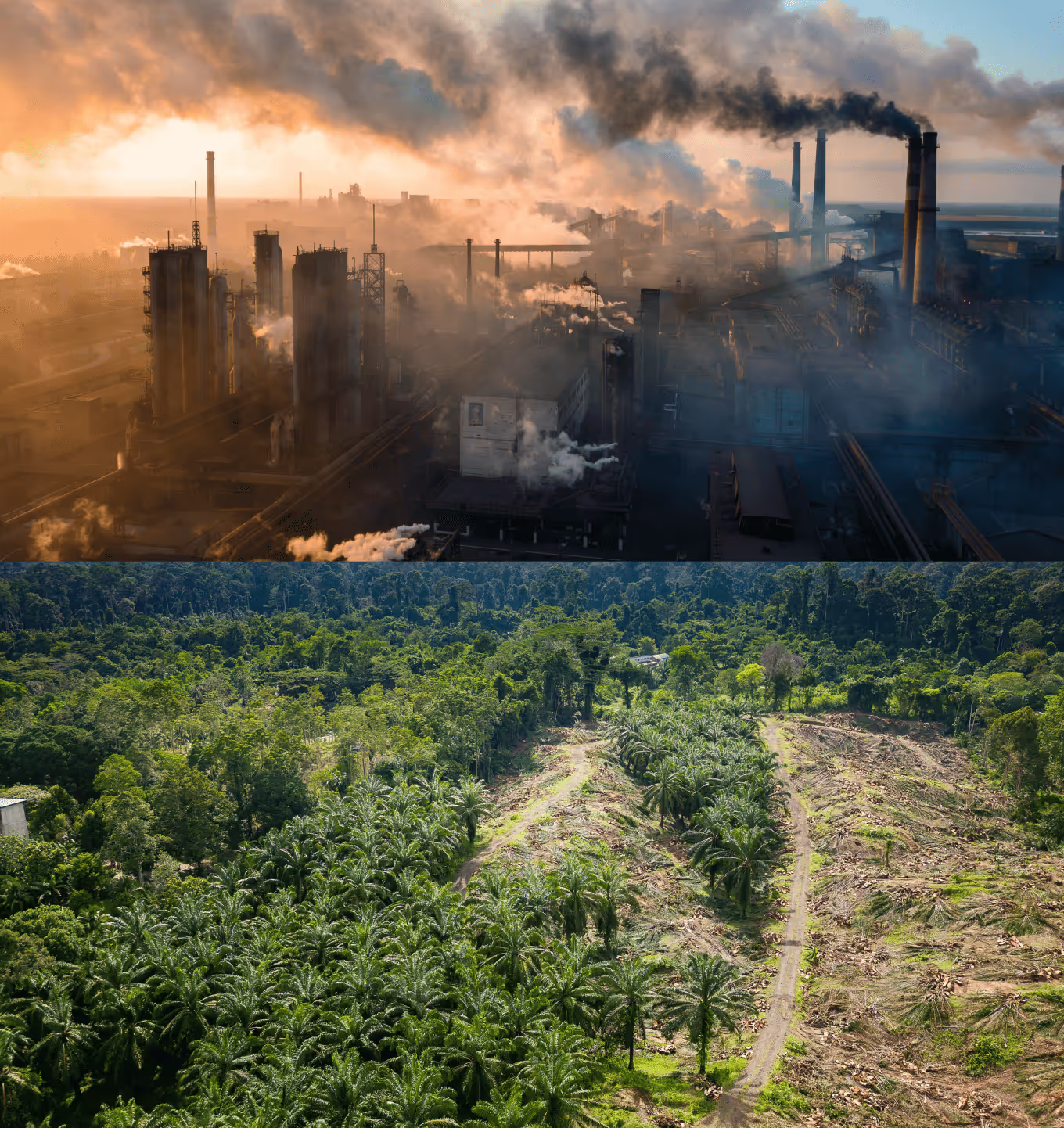
The chemical industry faces fundamental constraints from synthetic petrochemistry and traditionally-sourced renewable building blocks.
The limited chemical diversity in existing petrochemical building blocks constrains new product innovations, and modifying them to introduce complex stereochemistry or reactive group configurations can be economically infeasible due to multi-step processes with low reaction yields and high energy input. Meanwhile, traditionally sourced renewable building blocks are limited to chemistries which are already abundantly available in plants or animals.
Amyris' deep knowledge of biological chemistry enables us to produce sophisticated customized chemistries, enabling new performance materials with enhanced properties.
Our flagship example is trans-β-farnesene, a branched chain terpene with high isomeric purity. Farnesene is found in nature in vanishingly low quantities. By scaling up production of farnesene to the kiloton scale, we transformed it into a building block with relevance across numerous end-markets.
Farnesene’s unique structural properties opens the door to differentiated chemical and physical properties when formulated into performance materials such as elastomers, rubbers, and resins. It has also proven an ideal building block for ingredients used in the flavor, fragrance, beauty, and animal nutrition industries.
Farnesene is far more sustainable than comparable petrochemical building blocks. Across the production lifecycle, our farnesene boasts a 50-60% reduction in CO2 emissions relative to similar petrochemical feedstocks, even before all biogenic carbon credits are considered. Moreover, the simplicity of process inputs - yeast, sugar, and nutrients - enables clarity around traceability and LCA.
.png)
Performance and precision
The unique chemical structure of farnesene enables performance differentiation and delivers significant emissions reductions across performance materials, elastomers, and adhesives. Manufactured with the precision that only biology can deliver, Amyris Farnesene is available at 99.5% isomeric purity.
Cost and efficiency
Beyond performance materials, the use of Amyris’ farnesene as a building block for Vitamin E resulted in a 35% decrease in production cost by dramatically reducing complexity of the synthetic pathway.
Sustainable sourcing and market growth
Farnesene has enabled cost-advantaged production of fragrances with reduced reliance upon volatile botanical feedstocks. With dramatically lower environmental impact, farnesene has helped customers expand their markets as global demand increases.