EMERYVILLE, CA, September 8, 2026
Key Takeaways
- Cartographer™ is a platform that enables Amyris to more easily connect customer challenges and market needs to renewable solutions produced through precision fermentation.
- Customers can bring a specific challenge to Amyris, such as a performance requirement, a chemical motif or functional group, or a physicochemical property. Amyris then uses Cartographer to scan thousands to millions of molecules, identifying renewable chemistry that fits with the customers’ unique needs.
- Every candidate is evaluated against a proprietary layer of scoring metrics for manufacturability, built on years of data and experience scaling up molecules from the lab bench to industrial scale production.
- Cartographer has already been used to characterize properties across large classes of natural molecules and semisynthetic derivatives, creating new ingredient innovation opportunities across home care, personal care, beauty, and performance materials.
While some Amyris customers walk through the door with a specific target in mind, other customers are at an earlier stage of discovery. Some are intrigued by biotechnology and the benefits it can create with sourcing stability and sustainability, but they aren’t sure how biotechnology is relevant to the problems they are trying to tackle in their own industries.
Cartographer™ is a platform Amyris created to better connect customer challenges and market needs to renewable solutions produced through precision fermentation. To explain the problem it solves and how the method works, we spoke with two of the people closest to Cartographer: John Hung, Director of Technology Partnerships at Amyris, is in customer conversations every day, leading bench-to-bench discussions and translating customer’s technical requirements into renewable chemistry solutions. Onur Erbilgin, Senior Data Scientist at Amyris, is one of the key technologists who helped build the platform itself.
Q&A
What customer pain point was Amyris solving for when developing Cartographer?
Onur Erbilgin, Senior Data Scientist: Often, our customers don't come to us with a specific molecule in mind. Instead, they know the attributes they need: a certain solubility, a particular organoleptic profile, a reactive site for downstream chemistry, or a specific end-market application. Our job at Amyris has always been to translate those requirements into candidate molecules we can offer. Historically, that translation relied heavily on manual research and institutional knowledge. We built Cartographer to dramatically compress that process and enable us to search a far broader set of chemistry than would be feasible by hand.
John Hung, Director of Technology Partnerships: Early in our history, Amyris discovered that combining biology and chemistry could result in big market-wins. Examples of this include Squalane and Hemisqualane. However, uncovering the myriad molecules that can be built by fusing biology and chemistry is a major technical challenge, as is predicting the unique physicochemical properties that will make them useful in end applications across industries. Cartographer enables us to efficiently identify novel solutions across markets for our partners. This enables customers in more sectors to access the benefits of biotechnology: secure sourcing, reliable quality, renewable carbon, and more.
At a high level, what does Cartographer do? What makes it different from what Amyris has been doing the last 20 years?
Onur Erbilgin: At its core, Cartographer does three things. It researches, predicts, and organizes molecule attributes, building a structured knowledge base our teams and algorithms can search and query. It computationally generates novel structures from starting molecules and reaction pathways we already know we can produce at scale. And it filters and ranks those candidates against a target application, so we can quickly narrow a large field down to the most promising options. What makes Cartographer exciting is the breadth of chemistry we can now survey. Cartographer lets us systematically consider a massive design space far larger than could be evaluated by hand.
John Hung: Cartographer helps us answer questions like: “What novel molecules can be created by the Amyris platform via biosynthesis? How can those molecules be further derivatized using scalable, green chemistry to access novel functionalities? What are the key physicochemical properties for each of these molecules?” From there, our scientists can map the applications needs of our customers to what we know is possible to produce. For example, a very simple query might be from a specialty materials company who needs a molecule with a molecular weight between 200-300 Daltons, has a branched chain structure, and has a conjugated diene for use as a polymerization handle. Cartographer can help us find candidate molecules fitting that criteria that Amyris can produce.
What makes Cartographer unique in the industry?
Onur Erbilgin: Cartographer's outputs are grounded in nearly 20 years of manufacturing and scale-up experience, which lets us assess not just what molecule could work in a given application, but whether we can actually manufacture it. For example, Cartographer incorporates scoring models (based on predicted physicochemical properties) that predict how difficult or costly a given molecule would be to scale up. When Cartographer proposes a new semisynthetic route, it's drawing on our knowledge of which reactions and unit operations we can reliably run at high yield at scale, not just what's chemically possible on paper. And the same principle applies when we assess biosynthetic routes: for example, we know which enzymes tend to be more amenable to engineering, based on years of hands-on experience.
What is the typical timeline to find a solution with Cartographer?
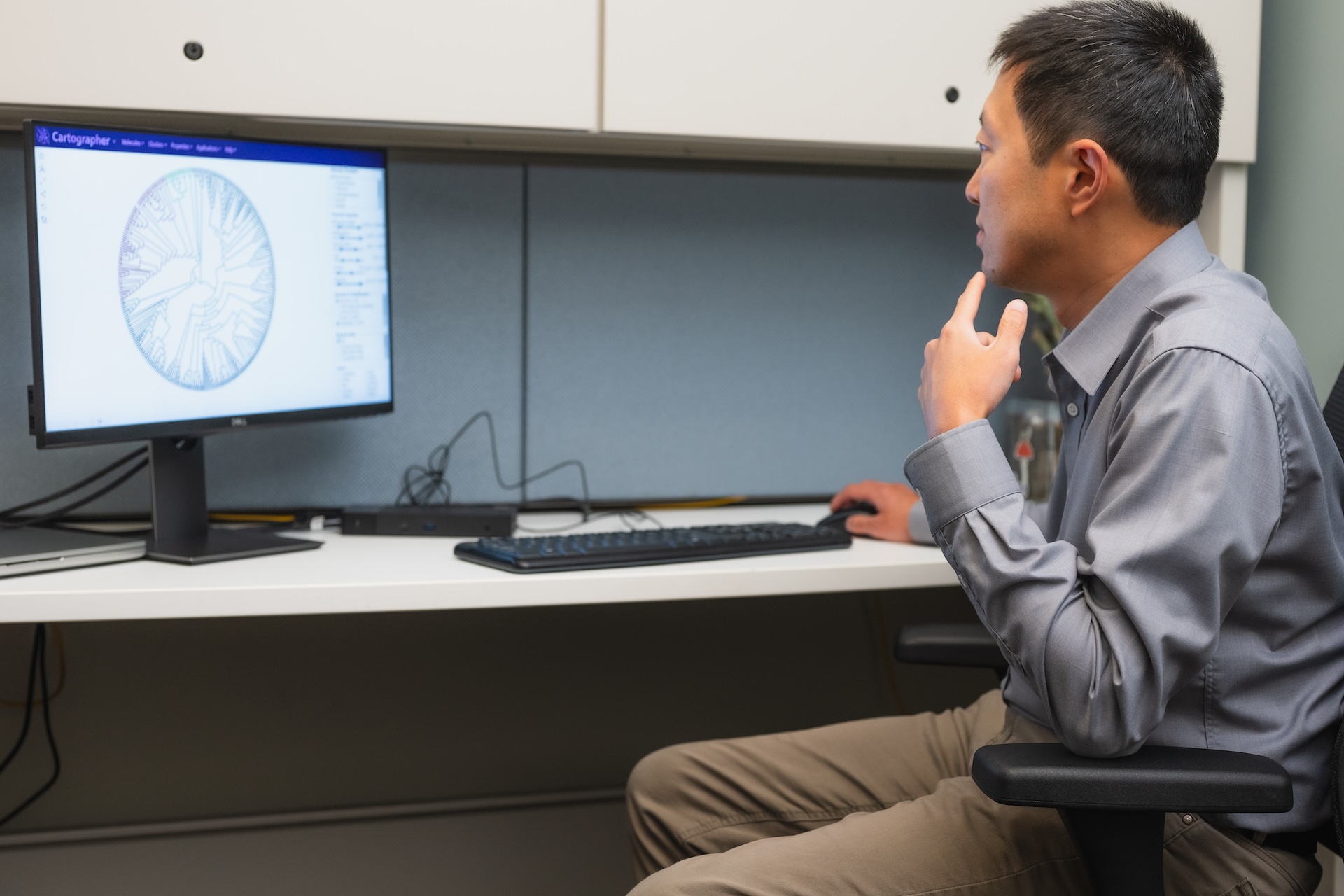
John Hung: Identification of new potential solutions is an iterative process. Once you get technical experts in a room, thinking 'bench-to-bench,' we can work with our partners to hone in on a lead quickly. The next step is testing the physical material in your application. Amyris is very strong at getting gram-to-kilogram quantities of novel materials into the hands of our partners for this stage of testing, and depending on the exact molecule, it can be as little as a few months. Cartographer greatly reduces the timeline to identifying a suitable target, scanning a broad set of chemistry for new and novel solutions, and ensuring that solutions are scalable from the beginning.
Which industries or types of companies/end-markets do you see most benefiting from Cartographer?
John Hung: Any industry that can communicate their needs to us in the language of chemistry or biology. Our scientists can take inputs from partners ranging in complexity from: “has antioxidant properties, is pH stable and clear,” to “polycyclic, no unsaturations and two terminal hydroxylations,” and rapidly find renewable, manufacturable solutions.
Onur Erbilgin: Any industry that relies on molecules with highly specified functional properties could benefit from Cartographer. Right now, we see the clearest, most immediate benefit in applications where structure-property relationships are clearly connected to performance in formulation. This would include fields such as cosmetics and industrial chemicals. Cartographer's property-prediction models are especially strong today, and we are actively expanding its capabilities in other end-markets as well.